
The Case For Community Supported Change Agents
Jul 31, 2026
Introduction
It is not a surprise to anyone that the way we reproduce social movements in the U.S is not very aligned with the values of movements themselves. Movements talk about building new worlds yet we typically organize ourselves in much the same way that businesses do: from funding and leadership development to strategy and tactics. With some notably radical exceptions, our conferences and gatherings tend to mirror the professional conference of businesses. Our leadership structures and management strategies draw from same set of best practices.
Most attempts to alleviate this mismatch between purpose and values with structure and operations run into familiar hurdles and dead ends. Co-directorship runs against expectations of funders and major donors to deal with a single leader. Furthermore, co-leaderships hits fundamental questions of accountability as most of our models of blame and responsibility function vertically with most shit rolling down hill and not laterally where the system may be more at fault than the individual.
Organizations are often faced with a double bind of either investing in the best professional practices of the mainstream economy (along with all the bias, discrimination, and inflexibility that they entail) or stepping into more liberated structures (along with all the emergent, ever-changing, messiness that they entail). While mainstream professionalism can be effective it can also feel inhumane, relying on existing problematic hierarchies of worth, and out of touch with the communities it seeks to work in. Liberating structures on the other hand ask people to show up as their whole selves which can mean traumatized, with long unmet needs and desires that no current structure can satisfy. Mainstream structures tie us to mainstream dysfunction, but liberated structures can internalize systemic dysfunction that no organization can tackle on its own.
Many organizations try to offer places for emotional conversation, trauma informed processes or other more humane practices only to open more emotion and depth of tension than they had the ability to hold. If an organization didn’t succumb to internal conflict, it risked losing its mission and becoming a self-help circle for staff. Yet rather than see this as a reason to remain in the inhumane devil we know, we should see this reason to movements to invest in organization structures and social infrastructure that can actually hold our whole selves.
Rather than think of organizations as building blocks of movements we should understand the role they play in modern political economies as more akin to private governments. They are the vehicles through which many public goods are consumed (like utilities and social trust) and accessed (health care, workforce development, social insurance). Our employers can determine what we can and can’t do or say for hundreds of hours of our waking lives. With the destruction of third places, they also tend to be our main sites for socialization.
It shouldn’t be surprising then that movement institutions face the same infighting, scandals and crises of legitimacy that every other institution in the U.S. is facing. As our comrade Reece Chenault said, it’s hard to organize Americans in America without dealing with typical American organizational problems. The ways we fund, develop, build, defend and fight for dreams of freedom are fundamentally at odds with the freedom we long for and thus incapable of achieving it.
In the same way that capitalism is not the only way to organize our political economy, firms are not the only organizational form that production and collaboration can take.
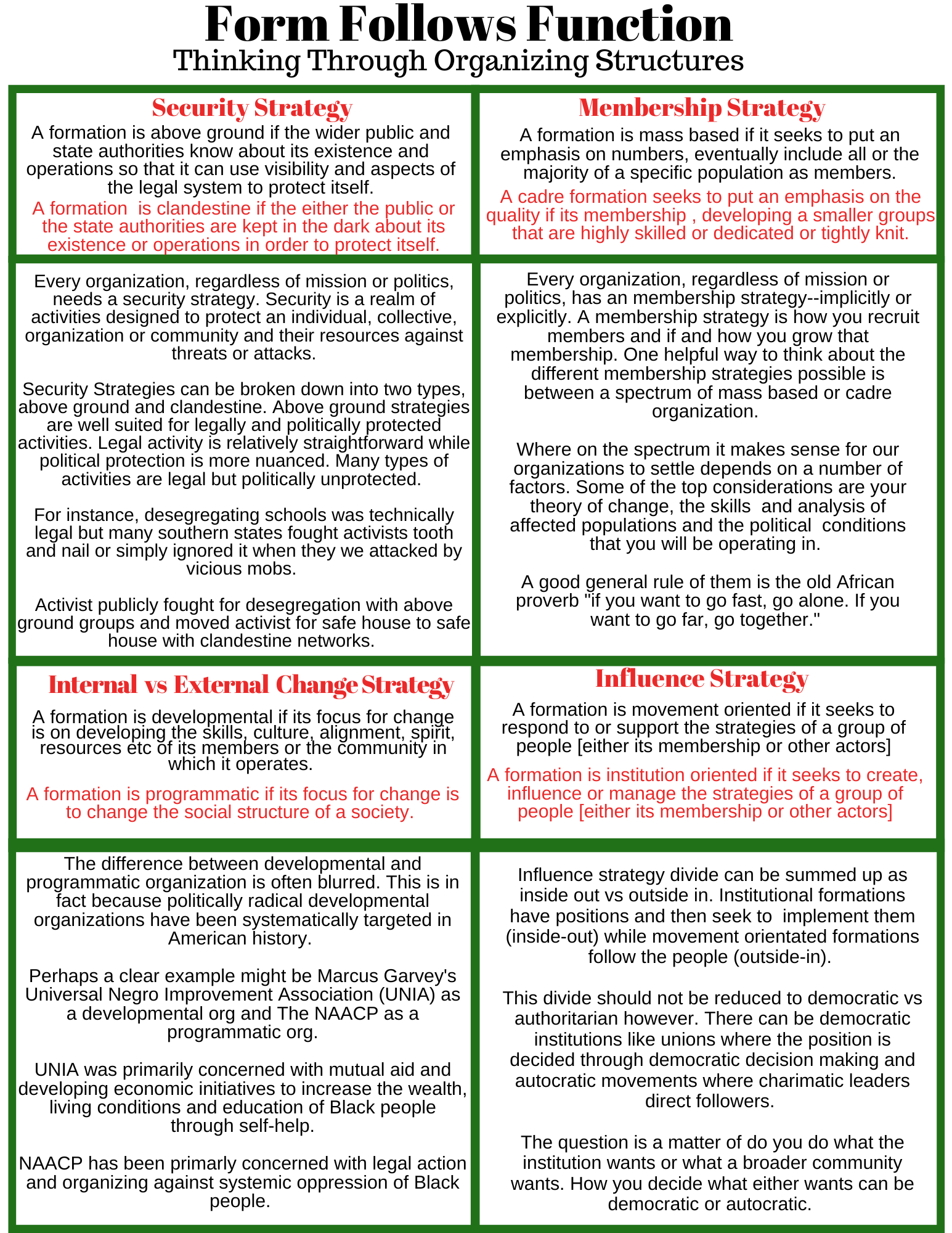
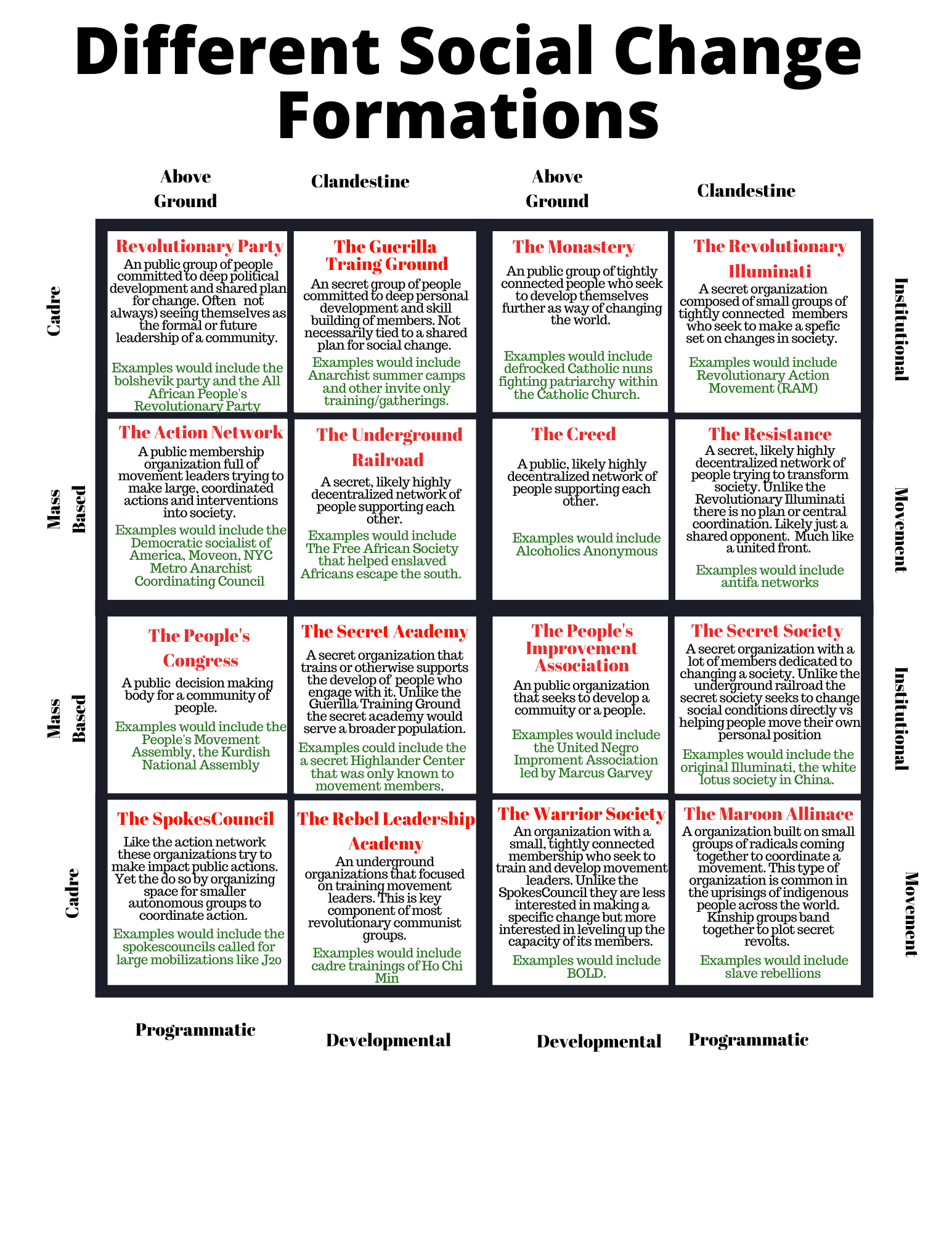
By splitting our financial security and benefits from our day to day activities we can free up organizers, activist and spiritualists to self-organize in new organizational forms. There is a reason that most vibrant and impactful work comes from unfunded affinity groups on the ground. People who come together for a shared purpose always do more innovative work than people who come together for a paycheck.
Unfunded affinity groups do not have to worry about organizational longevity, legacy, or legitimacy to funders. They don’t have to worry about wasting resources they don’t have. When they get into conflict, they also don’t have the added stress of putting people’s livelihoods on the line. Yet unfunded organizations full of unfunded people have a whole host of other problems. They tend to form deep trauma bonds with their comrades as people use the work of affinity groups as a vehicle to meet unmet needs subconsciously. The labor often falls apart due to people’s need to put focus on paid work.
What is needed is a new mode of social reproduction for movements that allow for people to meet their needs without automatically burdening them with organizational needs. This can be through having community supported change agents. That is to say, by developing vehicles by which communities can donate to individuals who have a track record of working for them. Their donations are not tied to a specific body of work but rather to specific organizers who are entrusted to go where community needs and their own sense of meaning take them.
By organizing these community supported change agents into affinity groups there can be peer accountability along with community accountability that does not require people to build “movement firms.” Your accountability group would make the people making sure you are working in alignment with shared values. Each organizes would be free to work in different emergent formations or as solo community practitioners free of philanthropic market or the mainstream market concerns.
To do this will require labor that has gotten a bad wrap in recent years, pre-figuration.
In Defense of Pre-Figurative Infrastructure
“The capital system under which we live is an organic system. Every part of it supports and reinforces the others. It is this kind of reciprocal support of the parts that makes the problem of revolutionary transformation very complicated and difficult. If you want to replace capital’s organic system you have to put in its place another organic system in which the parts support the whole because the parts also reciprocally support each other. This is how the new system becomes viable, capable of standing firm, growing, and successfully moving in the direction that secures the gratification of every member of society.” --Istvan Meszaros Socialism or Barbarism
With all of this tension in the offices mirrored with the conflict on the streets and the face of white supremacist backlash it is tempting for people to start to sour on the idea of “prefigurative politics.” It easy to turn against the idea that our means of getting free should reflect the kinds of freedom we want. That is to say, in many circles, the problem becomes this belief that things can be better now. Somehow, wanting our daily lives to free before the system is overthrown is the problem. We have to be realistic, they say. We must take the world as it is. They never recognize that this is exactly what capitalism doesn’t do. It refuses to take a relational world with fundamentally limited resources as it is.
When it comes to building the world we want, we rarely ask ourselves if we are prefiguring the wrong world. Is a professional work place the world we actually want? Do we still want bosses and jobs and philanthropy? Do we want to shame our collaborators into behaving differently around us? Do we want to keep making demands of system that was never meant to serve us?
I don’t think so.
I believe that the failure of prefigurative politics was not that the means cannot be the ends. The problem is that didn’t take dreaming of the worlds we want seriously enough.
Democracy is not a large public meeting of strangers in a park with terrible acoustics, no mic and no facilitator. Democracy is not “shared leadership” where accountability means blaming someone else. Liberation is not the result of weekend training on implicit bias.
Being honest with ourselves about the world that we want is devastatingly hard work. That’s why we avoid doing it. It can be fun to imagine a world of make- believe where we have telepathy and everyone loves each other. Yet when we try to make a grounded vision for ourselves in this world of deep relationality and finite resources, we are often met with a wall of grief about our unmet needs.
The pre-figurative infrastructure we need has to name, help us process and address those unmet needs. Pre-figurative politics cannot be about the settler-colonial imaginary—imagining a new terrain in which the contradictions of supremacy culture and capitalism don’t exist. We need to build infrastructure that is as organic and internally reciprocally supported as Capitalism is. This is why we developed our 5 movement structural interventions. We believe that these structures can be the heart of a new organic system that can be seeded on the small scale and allowed to grow.
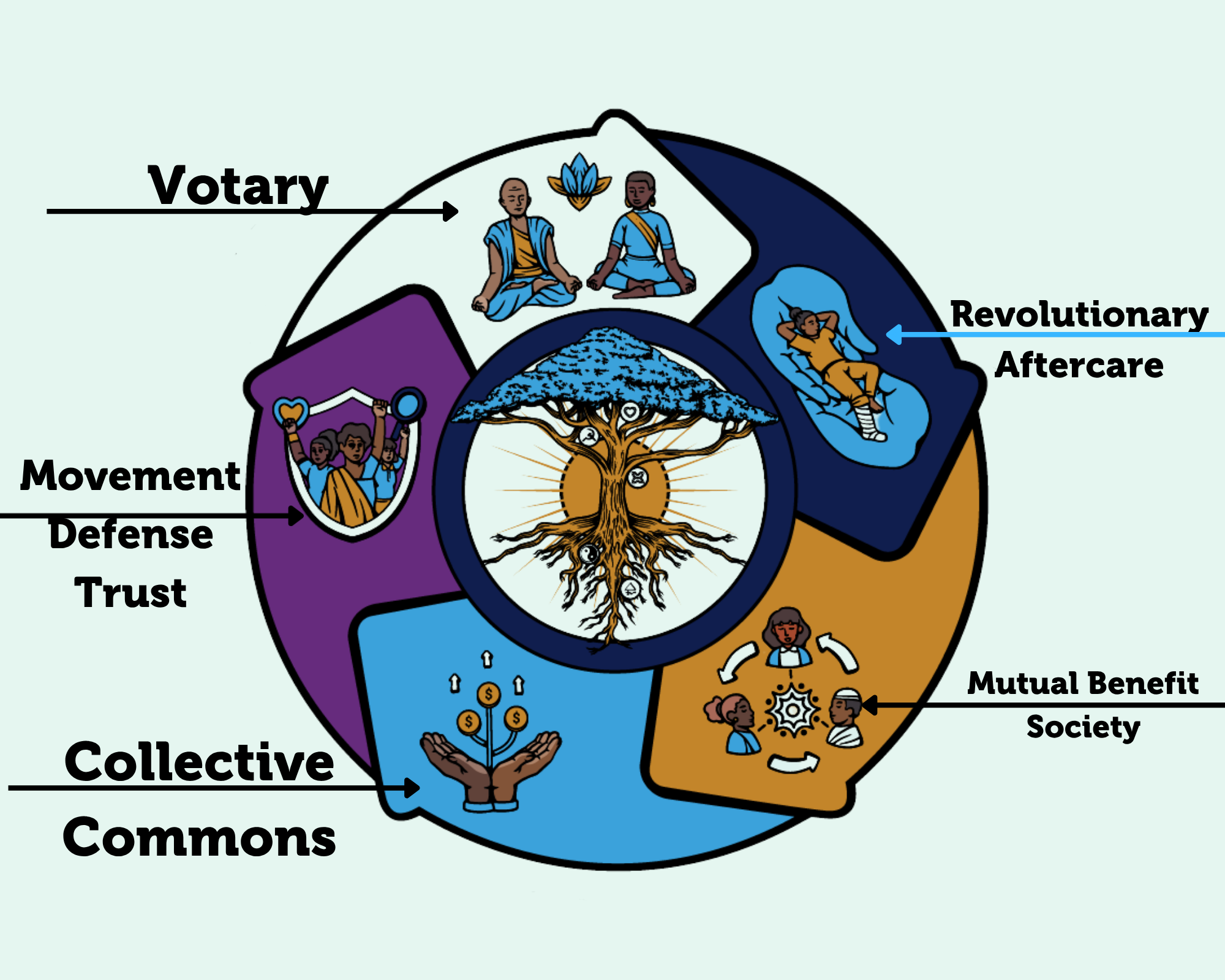
These interventions start with Revolutionary Aftercare where we offer wrap-around wellness, security & financial support to organizers in crises. Next our Votary supporting lifelong movement vocations where organizers are directly supported by and accountable to their communities. The Mutual Benefit Society which would nurture networks of care based on the logic of reciprocity & gifting. The Collective Commons which is a network of cooperatives with a shared credit system that would fund the other institutions. The Movement Defense Trust which would coordinate information processing, incident reporting and safety and security responses to help the ecology weather the inevitable backlash. We believe that if these infrastructural innovations could be brought into generative relationship a new class of people--the liberating common class--that exists outside the logic of capitalism, patriarchy and white supremacy could emerge and launch the kinds of innovative, love based abolitionist movements that this moment requires of us. You can read of brief overview here.
WildSeed As A Case Study
WildSeed embarked on trying to build a pre-figurative infrastructure 6 years ago. We call the way that we operate the WildSeed Way. We made a really dope e-comic book about it if you are interested. The key tenets of the framework are:
Centering Relationships: We focused on building trusting and honest relationships through loving, direct and honest communication. These relationships allowed us to state our needs and work to meet each other’s needs as possible while respecting our own boundaries. It also means talking through decisions and honoring the agreements we make with each other in an iterative manner. Any debts could be re-negotiated or expunged by mutual consent rather than being enforced regardless of context.
Sharing Resources: This means that we resource ourselves from a shared well. This meant splitting up income as it came in based on need. It also meant extending our personal relationship network to help get each other opportunities and using our skills for each other’s thriving.
Cultivating Compassion: This meant faithfully witnessing each other through difficult times and offering grace when we made mistakes. This always begins with self compassion, a commitment to loving all of me so that I can be compassionate with the parts of you that I find difficult in myself.
Offering Universal Care: This is the most crucial! Care does not have to earned nor is its responsibility gendered or raced. Everyone is worthy of care and everyone is responsible for caring for those whom they are in reciprocal relationships. Care means consensual acts taken to support someone else's wholeness.
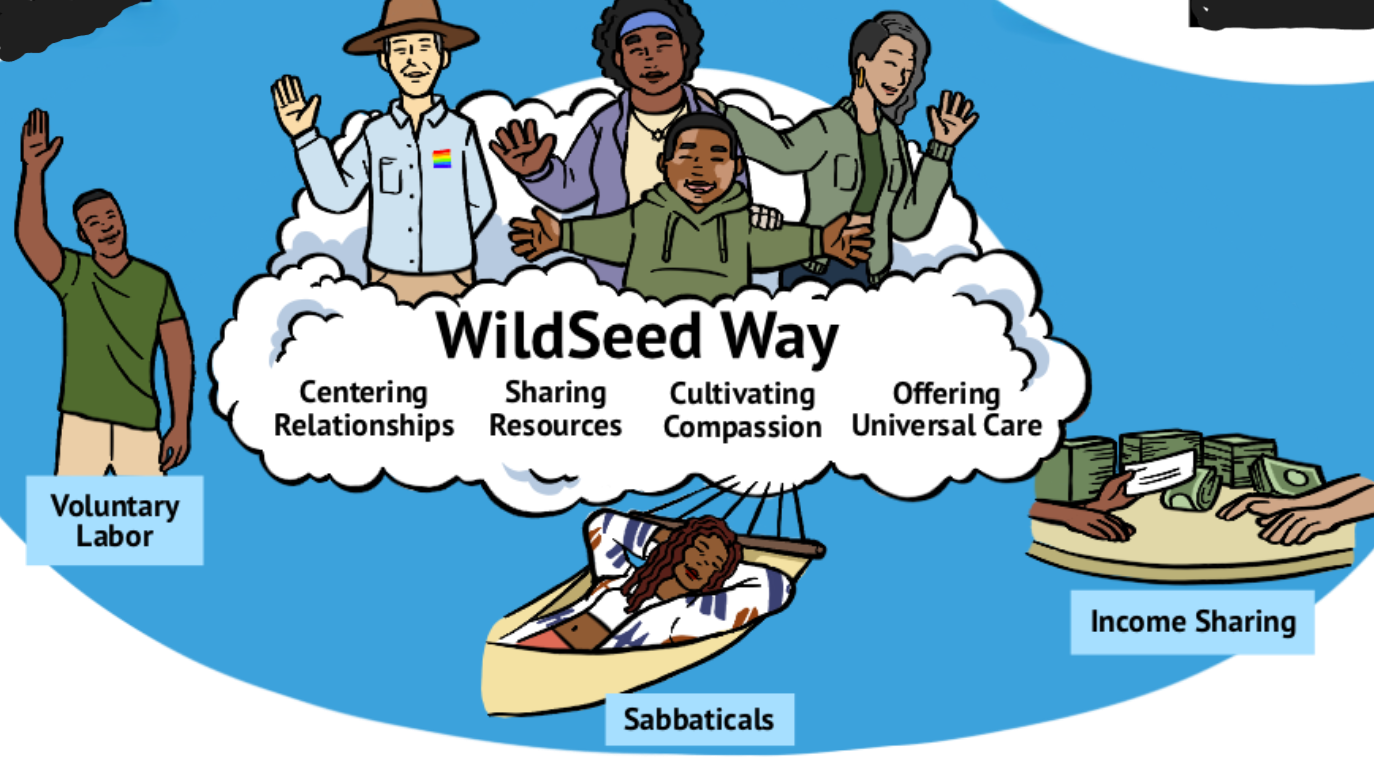
WildSeed has spent the last 6 years practicing this framework. We came to the conclusion years ago that our movements would fail if we kept organizing ourselves according to dictates of capital and the state. So we sought to abolish work as an organization. We sought to build an organization that could nurture the ecosystem where a new class of people—movement stewards supported by the community to live in a way that would free others—could grow and spread.
In the most important ways, the WildSeed Way has succeeded in that it allowed our team to flourish while helping others get free. We created a space where growth was encouraged, supported and resourced. People were asked to do only what they felt called to do and were given the space to explore that calling.
Yet the work of envisioning, drafting and legally constructing such an organization is expensive work. Making sure that it complies with all state and federal law and has the books to make funders comfortable funding it is a Sisyphean task. Though I love the philosophy of Camus, it was not possible to be Sisyphus and imagine myself happy. [I know that this is an obscure reference but those who get it will chuckle I assure you.]
Perhaps most importantly, it takes time to release all the shoulds and trauma and pain that has been pushing our work until we find the purpose that pulls us. When we find that purpose, there is no guarantee it is something fundable or commercially viable in the world that is. There is no guarantee that your comrades who you started out this journey with are the people you need for the next leg.
The tensions that have arisen in this process were new and totally different from what we had all experienced in other organizations. We did not fight over who got more money than who. We did not use titles or pay to show appreciation for the work. In fact we often solved big conflicts by having people go on sabbaticals. Yet it didn’t stop these tensions from sometimes being heartbreaking and gut wrenching.
When you pay people to just be they do not become more productive. They fundamentally change what, why and when they produce. Often, the total output is less and always, the amount of output that is recognized by the current financial system flatlines. We knew this. I knew this. Yet this decolonizing or thawing of our non-productive, human being or human doing selves was on an incompatible timeline with the rent, healthcare and living costs of humans in modern industrial capitalism selves.
One of the core tensions that arose is that team members who bought into the vision of the world the organization was trying to create knew that it is not in their calling to create an organization. The spirit tenders and ministers of pleasure we needed to craft the vision were not the organizational stewards we needed to build and maintain infrastructure.
Additionally, the healing work needed to experiment with working differently also changed our motivations. When given space our team realized that much of their past productivity was being pushed by pain, fear and trauma. Once that was gone there was lack of motivation. They ended up wanting to put more time into their family, health, communities and their own pleasure. While visions of new projects emerged it was not on a timeline that kept the lights on.
So even members who came in expecting to do administrative and organizational building work changed what they wanted to do. They often wanted to engage more in the core programming of helping people get free. They also wanted to do that in turn with their natural rhythms of rest and creativity. Out teams new rhythms were fundamentally unproductive in the most beautiful, values-aligned and spiritually guided ways. They were also simply not compatible with an organization that needed to speak to funders and the state while matching the rhythms of a community that was still trapped in the mainstream.
Most importantly, the emotional suck of doing work that was antithetical to their evolving purpose had drained much of the leadership of its creative energy. More heartbreakingly, the clashes we had about this when our nervous systems were under-resourced by grief, economic anxiety, trauma from the uprising and fear from slowly moving fascist coup had degraded the somatic trust we had in each other. Not that we became distrustful of each other but that it felt less safe to speak our truths and vulnerabilities to each other. Without these vulnerable truths we were stuck trying to visionary work as people we had healed beyond, unable to reintroduce ourselves to our beloveds and transform the work dynamic.
It is clear that the firm structure is not viable vehicle for WildSeed’s mission.
While it is true that with more funding we could have carried these contradictions for longer. It is also true that having a team of folks who are organizational builders would have been easier. Yet fundamentally more philanthropic reliance and less prefigurative job positions are at odds with the vision and touchstone (the felt sense of the labor the organization is meant to do).
The way forward is a lighter, more flexible organization without program staff. Instead we will have to spread out our staff into the different structures we have created like Coop and care pods so that they have more flexibility to meet their economic needs without needing as much dedicated back-office support. We will then focus on our efforts on pursuing the WildSeed Vision as we are individually called to do it on their own natural Rhythms. In short, we will step more fully into our ultimate vision of being community supported agents of change with your help.
Stay Connected with WildSeed Society!
Join our mailing list to receive the latest updates and offerings.
We hate SPAM. We will never sell your information for any reason.
